
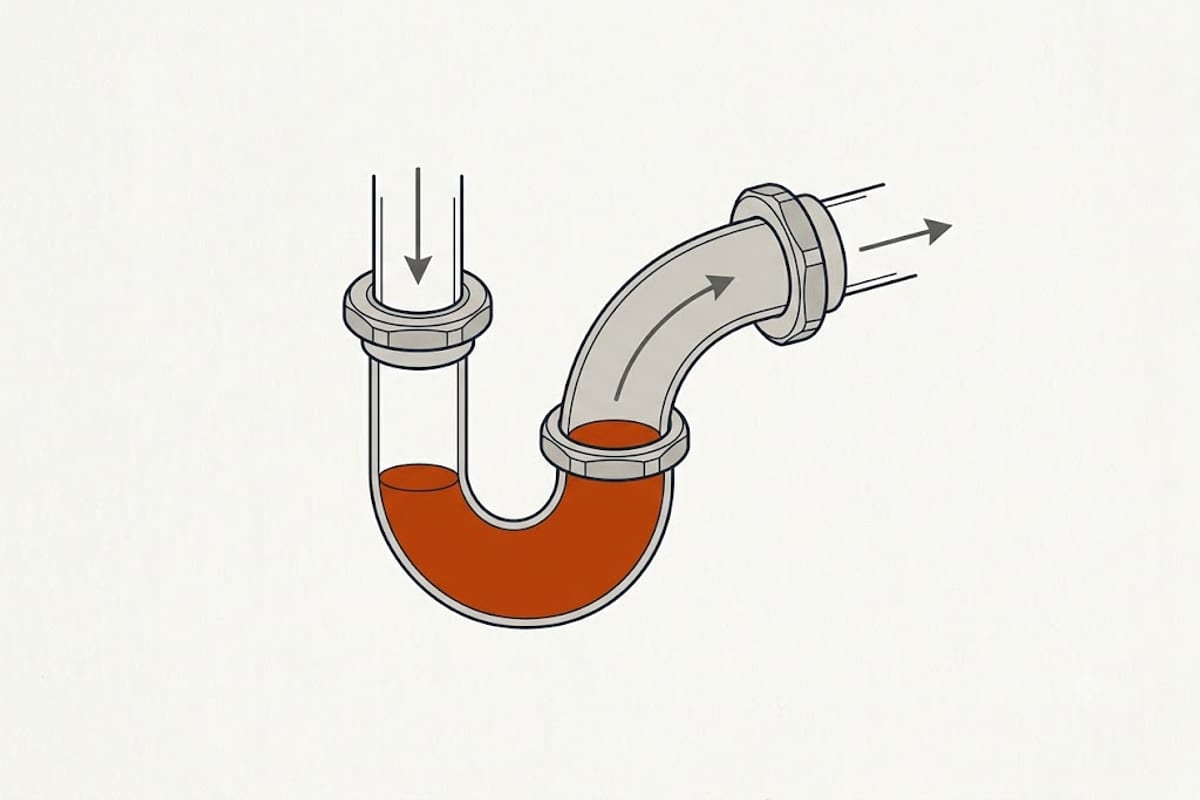
Under every fixture is a trap: a bend holding a small volume of water that seals the drain against sewer gas.
The seal
Codes specify a seal depth — commonly 2 to 4 inches of water between the weir and the dip.
Less and it is too easily lost. More and the trap becomes self-siphoning under some flows, which is why deep-seal traps are a specific product for specific situations rather than a general improvement.
The four ways it is lost
Evaporation. A fixture not used for weeks dries out. This is why a guest bathroom, a floor drain or a basement shower smells after an absence. The remedy is to run the tap, or to add a small amount of mineral oil to a floor drain that is rarely used, which floats and slows evaporation.
Siphoning. Flow past or through the trap draws the water out, from an inadequate vent or a trap arm that is too long. The classic symptom is a gurgle followed, days later, by a smell.
Back pressure. A discharge elsewhere pushes air through the trap, blowing the seal out. Also a venting fault.
Capillary action. A thread, a rag or a build-up of lint lying over the weir wicks the water out slowly. Uncommon and real.
Three of the four are venting or maintenance. One is a piece of fluff.
S-traps
An S-shaped trap, where the outlet runs vertically down immediately after the bend.
The vertical drop below the trap is exactly what siphons it — the falling water pulls the seal with it.
S-traps are prohibited in modern codes and they are still found in older houses and in DIY work. The fix is to reconfigure to a P-trap with a properly located vent, or where the code permits, a P-trap with an air admittance valve.
A fixture that repeatedly smells and gurgles despite being used regularly is worth looking under, because this is frequently what is there.
Bottle traps and drum traps
Bottle traps — common on some basins and decorative wastes — are permitted in some jurisdictions and not others, and they hold debris.
Drum traps are found in old houses under baths. They block easily, they are hard to clean, and they are not permitted in new work. When a bathroom is opened up, they are replaced.
The washing machine standpipe
A standpipe has a trap at its base and its own set of rules: a minimum and a maximum height for the pipe, and the hose inserted rather than sealed in, so the pipe can admit air.
Too short and the machine's discharge overwhelms it and overflows. Too tall and the pump struggles. Sealed in and it siphons.
A washing machine that gurgles the nearest fixture when it drains is a venting problem, and it is one of the most common in the house because a machine discharges far faster than any other fixture.
Cleaning under a trap
Most P-traps have slip joints and come apart by hand or with light tools, over a bucket.
That is where a dropped ring is, and it is the first place to look for a slow basin before anything is poured down it.
Chemical drain cleaners are worth avoiding: they sit in the trap, they damage some materials, and they make the eventual mechanical clearing hazardous for whoever does it.
Trap primers
Where a floor drain is required and rarely used — a mechanical room, a garage — a trap primer feeds a small amount of water to it periodically so the seal cannot evaporate.
Some jurisdictions require one on floor drains. Where none is fitted, pouring a cup of water down every month or two does the same job, and mineral oil on top of it slows evaporation further.