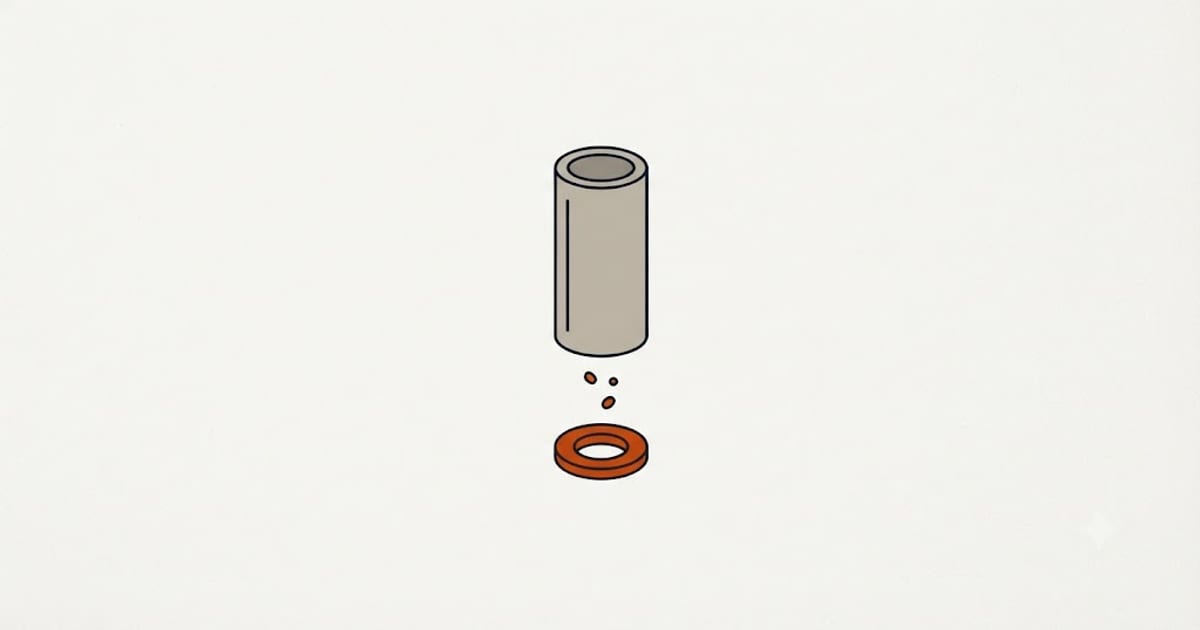
If one tap is weak and every other outlet in the house is normal, this is not a water pressure problem. Pressure is a property of the supply, shared by everything connected to it. What you have is a restriction, and it is somewhere between the branch and the spout — usually within a foot of it.
The good news is that the order of likelihood is also the order of cost.
The two-minute test that splits the problem
Run the tap on hot only, then cold only.
- Both weak → the restriction is downstream of where they meet: the aerator, the cartridge, or the spout.
- One side weak → the restriction is on that side: that supply stop, that flexible connector, or that inlet screen.
- Hot weak at several taps → not this article; look at the water heater's outlet and the shut-off above it.
That single observation eliminates most of the list.
1. The aerator
Unscrew the screen at the end of the spout — by hand, or with tape around it and pliers so as not to mark the finish. Look at the mesh against a light.
Aerators collect scale, grit and, in older houses, small black rubber fragments from a deteriorating washer or supply hose. On a tap that has been in service some years, and especially after any work on the mains, this is the answer more often than everything else combined.
Soak it in vinegar, rinse it out, refit. If the flow returns with the aerator out and stops when it goes back on, you have found it.
2. The supply stops under the sink
The small angle valves feeding hot and cold. Two things go wrong with them:
They get partially closed — during a repair, by a cleaner, by a child, or by someone who shut them and only half reopened them. Turn each fully anticlockwise and see if anything changes.
They seize or silt up internally. Multi-turn stops that have not been operated in fifteen years frequently will not fully open again, and the rubber washer inside can swell or break loose and sit across the outlet. If the hot-only or cold-only test pointed at one side, this valve is the prime suspect.
3. The flexible connectors
The braided hoses between the stops and the tap. Their bore is small to begin with, and they have an internal washer that can deteriorate, swell, or fold over. They are also frequently kinked behind a waste trap where nobody looks.
They are inexpensive, they are a wear item, and replacing a pair takes fifteen minutes. If the tap is over ten years old and everything above has been eliminated, replace them rather than diagnosing further.
4. The cartridge
Inside the tap body. Cartridges scale up, particularly in hard water, and single-lever mixers have small internal passages that are easy to block. On a mixer the symptom is often that flow is poor across the whole lever travel but the temperature range still works.
Cartridges are model-specific. Take the old one to the merchant rather than ordering by guesswork.
5. Debris from recent work
If this started immediately after a repair, a new water heater, or work on the street main, the cause is almost certainly a slug of scale or sediment dislodged upstream and now sitting in the nearest restriction. It typically lodges in the aerator, the stop, or the cartridge — in that order.
Flush the line before reassembling: with the aerator out and the tap open, run the water for a minute to clear what is loose rather than pushing it into the next component.
Two things that are not the cause
A pressure regulator. A failing PRV affects the whole house, not one tap. If only one outlet is weak, the regulator is not it.
The municipal supply. Same reasoning. Where the street pressure genuinely drops, every tap goes weak together, and the neighbours notice at the same time.
Where a single weak tap points at something bigger
There is one exception worth knowing. If the weak tap is the furthest fixture from the supply, and it is weak only when something else is drawing water, then the restriction may be the branch pipe itself — undersized, or narrowed by corrosion in a galvanised system.
That is a real plumbing job rather than a fifteen-minute one. The distinguishing symptom is that it is fine on its own and collapses when a second fixture opens, which none of the five causes above will do.