
A washing machine empties faster than almost anything else in the house. A pump discharges 15 to 20 gallons in under a minute, and that slug of water moving down the drain drags air with it. The air has to be replaced from somewhere.
If the vent system can supply it, nothing happens. If it cannot, the drain takes air the only other way available: through the nearest trap, pulling the water out of it. That is the gurgle.
Why the gurgle matters more than the noise
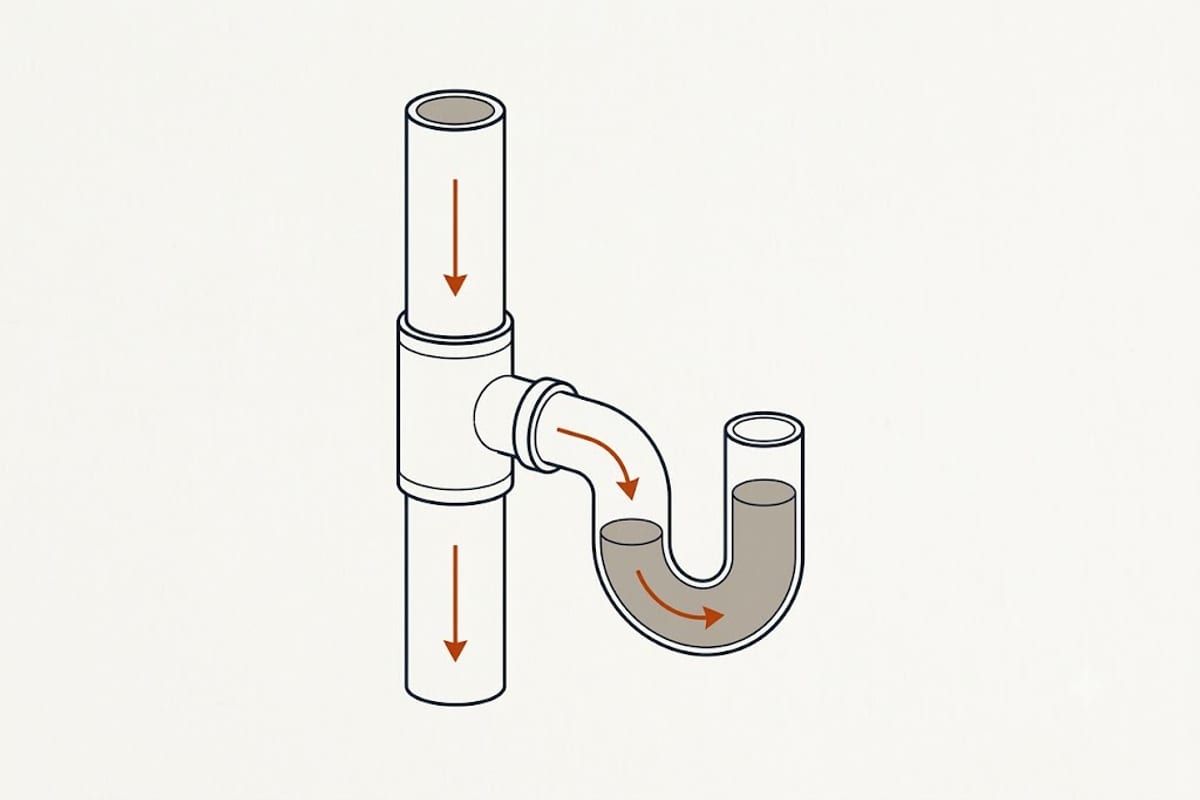
The water sitting in a P-trap is the only thing separating the room from the drain system. Empty it and sewer gas has an open path indoors.
A gurgle is the sound of that seal being partially emptied. It usually refills from the next use, so nothing is noticed. But a floor drain, a guest bathroom or a basement sink that gurgles and is then not used for a week has a dry trap and an open door — which is why "there is a smell in the basement and we cannot find it" so often follows a gurgle nobody thought was important.
The four causes, in order
1. A blocked or restricted vent. The vent terminates on the roof and it is outdoors, so it collects everything outdoors collects: leaves, a bird's nest, a tennis ball, frost. In cold climates the vent can ice over from moist air condensing and freezing at the terminal, which is why this problem is famously seasonal in northern houses — it appears in January and disappears in March.
This is the most common cause and the most checkable one.
2. A partial blockage in the drain itself. A restriction downstream turns a free-flowing drain into one that runs full, and a pipe running full behaves like a siphon. The washing machine's fast discharge is simply the biggest slug of water the system sees, so it is the one that reveals a restriction everything else is passing.
The clue is that the drain is also a little slower than it used to be — often too gradually for anyone to have noticed.
3. An S-trap, or a fixture with no vent at all. Older installations and DIY work often have a trap with no vent between it and the drain. These self-siphon by design: the water leaving pulls the trap seal out behind it. This is not something to fix by clearing anything — it needs a vent, or an air admittance valve where the local code permits one.
4. An air admittance valve that has failed. AAVs are mechanical, they are usually under a sink or in a wall cavity, and they stick. When one fails closed it stops admitting air and the fixture behaves as though it were never vented. They are inexpensive and they are a consumable, not a permanent fitting.
Working out which one you have
Does anything else gurgle?
- One fixture only, near the washing machine → that fixture's trap or its vent connection. Look at causes 3 and 4 first.
- Several fixtures, or the toilet bubbles → a main vent or a main drain problem. Causes 1 and 2.
Does it change with the weather? Appearing in freezing weather and going away in spring is a frozen vent terminal, effectively confirmed.
Is the drain slower than it was? Slow and gurgling points at a partial blockage rather than a vent.
Is there an AAV under a nearby sink? A white plastic dome on a vertical pipe. Removing it temporarily and running the machine will tell you: if the gurgle stops and the smell arrives, the valve was the problem.
What to do about it
A roof vent can often be cleared from above by running a hose down it, which floats out leaves and nests. This is roof work; if the roof is steep or high, it is a job for someone equipped for it, not a Sunday afternoon.
A drain blockage wants a proper cleaning of the branch, not a bottle of chemical. Drain chemicals rarely clear a partial obstruction in a horizontal run, and they make the eventual mechanical job hazardous for whoever does it.
An unvented trap needs actual plumbing. An air admittance valve is the usual retrofit answer where code allows, but they are not accepted everywhere and they may not be used for the vent serving a whole building.
A failed AAV is a straight replacement, and it is the cheapest good outcome on this list.
The thing not to do
Do not ignore it because the noise is tolerable. The noise is not the problem — the noise is the report of a problem. What is actually happening is that trap seals are being pulled, and the failure mode at the end of that road is sewer gas indoors, from a fixture nobody has used recently and nobody thinks to check.