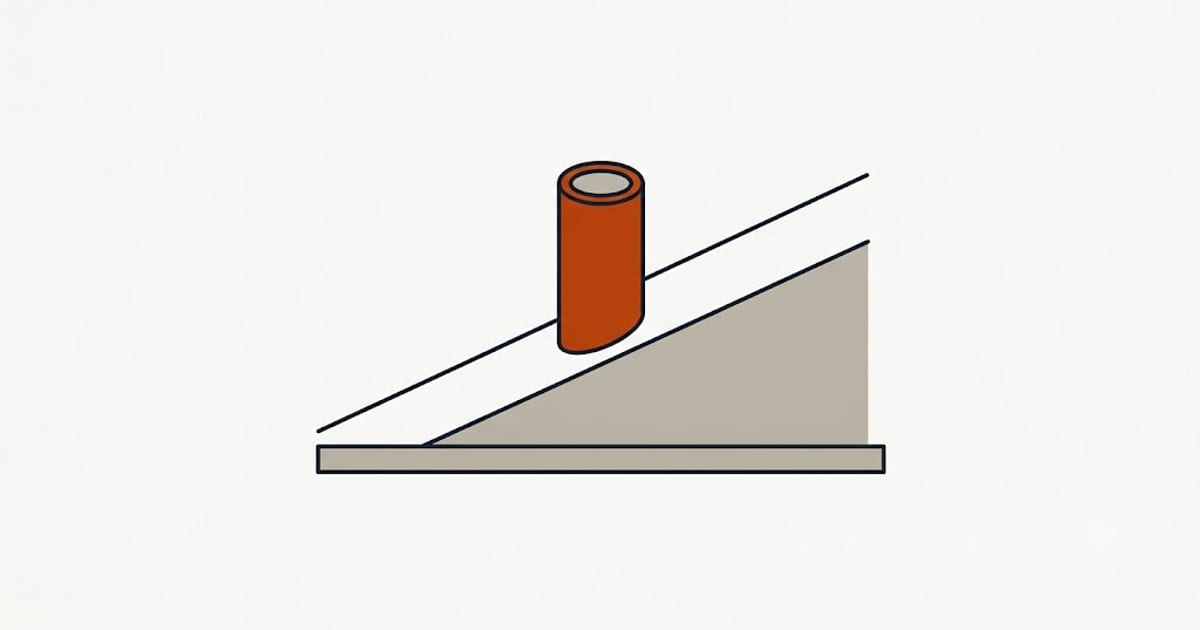
Vents work by admitting air, and they only do that if the opening at the top is open.
The rules at the top
A minimum height above the roof surface, so it is not covered by snow or by debris and so the flashing works.
A distance from any openable window, door or air intake — including the neighbours' and including a mechanical ventilation intake — so sewer gas is not drawn back in.
Not under an overhang or a soffit, where the gas would collect.
Flashed properly, since it is a penetration through the roof and it is a common source of leaks.
Frost closure
The air rising through a vent from inside the house is warm and moist. In a cold climate that moisture condenses and freezes on the inside of the pipe near the top.
Over a cold spell the frost narrows and eventually closes the vent, and then the whole house gurgles and drains slowly.
The remedy in the code is an increase in vent size through the roof in cold regions — the larger pipe takes far longer to close.
The remedy on an existing house is clearing it, which usually means hot water poured down from the roof, and then increasing the size before the next winter.
The tell is that the symptoms appear in a cold snap and resolve in a thaw.
Other blockages
Nests. Birds and wasps find an open pipe attractive, which is why a screen is sometimes fitted — and a screen itself frosts and clogs, so it is a trade rather than an improvement in a cold climate.
Leaves and debris, on a vent under a tree.
A ball or a toy, occasionally.
Ice from a roof above, where a vent terminates below a higher roof plane.
The symptoms of a blocked vent
Exactly those of no vent at all:
Gurgling at fixtures, particularly when another drains.
Slow drainage everywhere.
Sewer smell, from traps being siphoned.
A toilet whose level rises and falls.
Because they appear together and across the house, they are frequently attributed to a blocked drain — and a drain cleaning company will clear a drain that was not blocked.
A blockage in the drain slows one branch. A blocked vent affects everything. That distinction is the first thing to establish.
Checking it
From the roof, with appropriate care, a torch down the pipe and a hose run into it. Water backing up means a blockage below.
That is a job for someone comfortable on a roof, and where it is not, it is a service call rather than a project.
Reducing the number of penetrations
Vents can be combined into fewer stacks where the code permits, which reduces the number of roof penetrations and therefore the number of potential leaks.
That is a design decision made at construction. On an existing house it is not worth opening walls for, and it is worth knowing when a roof is being replaced — the flashings around each vent are renewed at that point, and a poorly flashed vent is a common source of a roof leak that gets blamed on the shingles.
Air admittance valves as an alternative
Where permitted, an AAV under a sink replaces a vent run to the roof for that fixture.
They avoid a penetration entirely, they are mechanical and fail eventually, and every system still needs at least one vent to atmosphere. They reduce the number of stacks; they do not eliminate them.
After roof work
A vent flashing disturbed during a roof replacement, or a pipe cut short and not extended, produces both a leak risk and a vent that no longer meets its height requirement.
Walking the roof after any roofing work — or asking for photographs of each penetration — is worth the ten minutes.